

government office interior design Bangladesh: Ceilings, Lighting & Cabinetry Best Practices
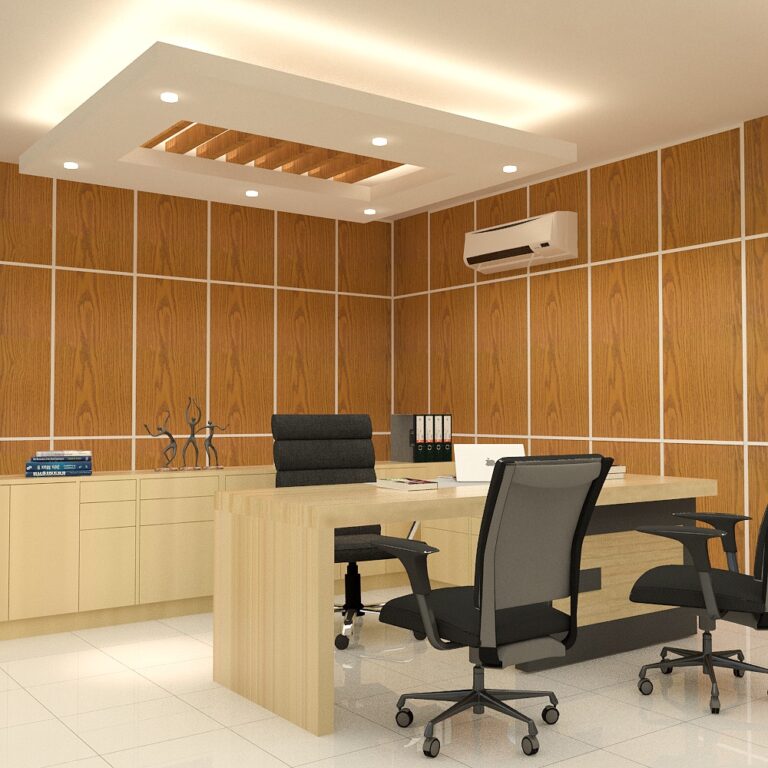
Well‑designed government offices communicate order, accessibility and durability. This article uses a recent Best Interior project — a refined government office with a geometric false ceiling, warm cove lighting, wooden wall cladding and built‑in cabinets — as a starting point, then explains practical, code‑aware strategies you can apply across public buildings in Bangladesh. Contact Best Interior for a site visit and quotation if you’d like a local assessment and an estimate.

Why design matters for government office interior design Bangladesh
Government interiors must balance public circulation, staff efficiency, and long‑term maintenance. Design choices affect wayfinding, perceived professionalism and lifecycle cost. Follow the Bangladesh National Building Code (BNBC 2020) for lighting, ventilation and occupancy requirements while prioritising durable finishes and clear circulation paths to serve diverse users and visitors. For guidance on office layouts and costs in Dhaka, see our Office Interior Design in Bangladesh post.
government office interior design Bangladesh: Ceiling & lighting strategy
Ceilings and lighting are the most visible signals of a well‑managed public interior. A layered geometric false ceiling with recessed modules and a slatted centre feature provides visual hierarchy while creating tidy runs for lighting, HVAC diffusers and cabling. Lighting strategy should combine ambient, task and controlled daylight to meet recommended illuminance targets.
- Design targets: aim for maintained illuminance around 300–500 lux on general work surfaces; provide brighter task lighting where needed. See guidance from CIBSE/IES for office lighting levels and glare control (CIBSE Lighting Guide).
- Layer lighting: use warm cove lighting in reception and approach zones, neutral or adjustable colour temperatures at desks, and recessed panels for uniform ambient light.
- Controls and zoning: include dimmers and scene controls in meeting rooms and presentation areas to reduce glare and manage power use.
- Daylight and partitions: frosted glass partitions keep daylight flowing into interior zones while preserving privacy and reducing reliance on artificial lighting.


Cabinetry & materials for Bangladesh’s climate
Humidity and seasonal variations in Bangladesh mean material selection and detailing are critical for lasting cabinetry. Cross‑laminated plywood or marine‑grade plywood cores outperform standard particleboard in humid climates: plywood resists swelling and delamination when properly sealed. Practical millwork steps include acclimatising panels on site before installation, using moisture‑resistant adhesives and sealing exposed edges.
- Prefer plywood cores with factory‑sealed edges and water‑resistant adhesives; avoid exposed particleboard in high‑humidity areas.
- Leave small movement gaps between built‑ins and external walls and finish joints with flexible sealant to prevent moisture ingress.
- Choose finishes that tolerate cleaning and UV exposure; regular touch‑up plans extend life expectancy.
- For inspiration on panel types and acoustic wall solutions, review our Acoustic Wood Wall Panels page.
Acoustics & privacy: practical responses
Public offices need a mix of open areas and confidential spaces. Acoustic design reduces distraction and supports speech privacy for interviews and meetings.
- Partitions: for fixed interview rooms target an STC (sound transmission class) around 40 to achieve adequate privacy where required (Armstrong office acoustics guide).
- Ceiling treatments: use absorptive backing or acoustic tiles behind false ceilings and include soft finishes (panels, furniture, curtains) to break up sound paths.
- Layout: position public counters and interview rooms away from open‑plan work areas, and use staggered circulation to reduce crowding noise.
Space planning, circulation and partitioning
Clear circulation, accessible counters and labelled storage improve service speed and reduce confusion. Frosted glass partitions are an effective way to create interview rooms that feel open yet private. Reception zones benefit from warm accent lighting and a clear visual path to public counters. Consider dedicated staff zones for records and stationery with lockable, labelled cabinets to simplify operations.
Maintenance, operations and lifecycle considerations
Ongoing maintenance preserves finishes and protects performance. Mild operational rules reduce long‑term costs:
- Run HVAC consistently to control humidity and protect wooden joinery; schedule regular filter and duct cleaning.
- Inspect joinery seals and edge bands annually; re‑seal or touch up finishes as needed to prevent moisture damage.
- Maintain lighting fixtures and replace lamps/LED drivers before output falls below design illuminance.
- Document spare parts and finishes to ease repairs and maintain visual consistency.
Design highlights: how the supplied project illustrates best practice
The Best Interior project in this folder shows several recommended practices: a layered geometric false ceiling for neat service routing, warm cove lighting for a welcoming approach, frosted glass partitions for privacy with daylight access, and built‑in cabinetry with coordinated wooden wall cladding. These elements together improve wayfinding, reinforce professional identity and simplify maintenance when detailed with moisture‑resistant millwork and controlled HVAC.
If you are planning a government or institutional fit‑out, we can advise on layout, material selection and maintenance planning. For more examples of office systems and furniture, see our pages on Office Cubicles in Dhaka and contemporary conference tables.
বাংলায় সংক্ষেপে
সরকারি অফিসে সিলিং, লাইটিং ও টেকসই মিলওয়ার্ক একসাথে পরিকল্পনা করা উচিত।
ক্রস‑ল্যামিনেটেড প্লাইউড এবং সিলযুক্ত এজ আর্দ্রতায় ভালো টিকবে।
কোভ লাইটিং ও ফ্রস্টেড গ্লাস দিয়ে অভ্যর্থনামূলক কিন্তু প্রাইভেসি রক্ষা করা সম্ভব।
FAQ
Which ceiling finish reduces noise?
Use acoustic backing in false ceilings and absorptive ceiling tiles; combine with soft furnishings and partitions to control reverberation (Armstrong).
Is plywood necessary in Dhaka’s humidity?
Plywood (properly sealed) is more resilient than particleboard in humid climates; it better resists swelling and delamination (technical note).
How to meet BNBC lighting and ventilation rules?
Follow BNBC requirements for minimum ventilation and lighting provision and use CIBSE/IES guidance for illuminance targets (typically 300–500 lux for general office tasks). Check BNBC 2020 clauses relevant to your occupancy type (BNBC 2020).
Sources
Key references used in this article:
- CIBSE Lighting Guide – Office lighting recommendations
- Bangladesh National Building Code (BNBC 2020)
- Armstrong – Office acoustics guidance
- Plywood vs particleboard – moisture performance notes
- Millwork humidity‑proofing guidance
Website reference: Visit the website.
0 comments